Flight Operations

Operational procedures, decision-making, and standard practices.

4
Free Questions
54
Premium Questions
Aug 15, 2026
Last updated

Questions and model answers

12 questions on this page

General Flight Operations 7 questions
What is RVSM? Answer available

RVSM stands for Reduced Vertical Separation Minimum. It is the application of a reduced vertical separation of 1,000 ft (300 m) between FL290 and FL410 inclusive in designated RVSM airspace.

RVSM increases airspace capacity and allows more aircraft to operate near their optimum cruise levels. Operating in RVSM airspace requires the applicable aircraft airworthiness approval, operational approval and procedures.

Required RVSM equipment

Under EASA rules, the aircraft must have:

  • Two independent altitude-measurement systems.
  • One altitude-alerting system.
  • One automatic altitude-control system.
  • An SSR transponder with altitude reporting, connected to the altitude source used for altitude control.

Before entering RVSM airspace, the required equipment must be operating normally. Under EASA procedures, at least two primary altitude indications must agree within 200 ft. This is an agreement tolerance between the indications, not a statement that each altimeter is accurate to ±200 ft.

What happens after an equipment failure?

If the automatic altitude-control capability required for RVSM is lost after entering the airspace:

  1. Maintain the cleared flight level as far as possible while assessing the failure.
  2. Inform ATC using the phrase “UNABLE RVSM DUE EQUIPMENT”.
  3. Request and coordinate an appropriate revised clearance.

ATC may apply 2,000 ft vertical separation, provide horizontal separation, or clear the aircraft out of RVSM airspace. A descent below FL290 is therefore not automatic, and the crew must not leave the cleared level without a clearance unless an immediate deviation is required for safety.

Always apply the aircraft procedures, the operator’s Operations Manual and any regional contingency procedure.
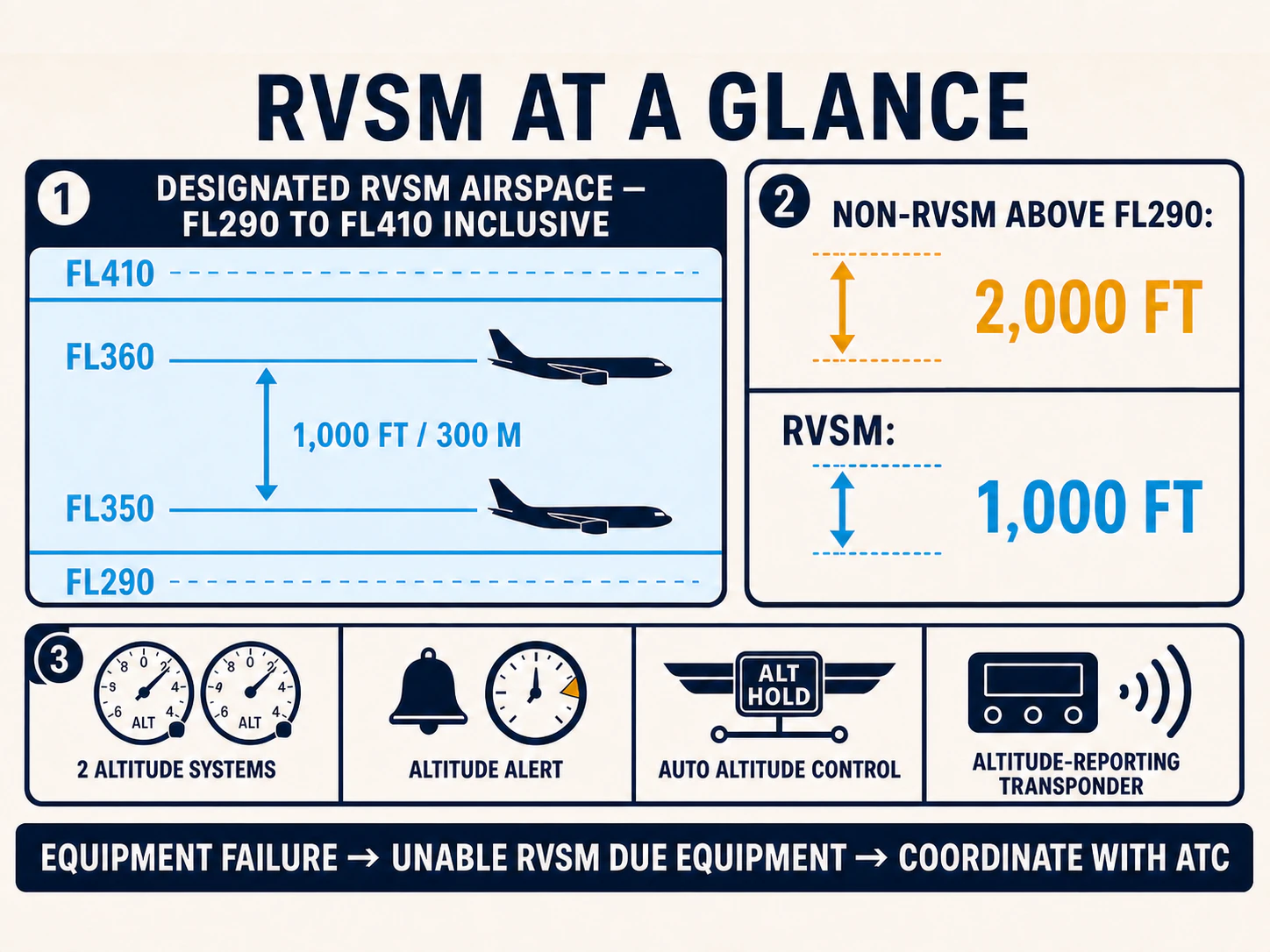
RVSM and non-RVSM vertical separation, required equipment, and equipment-failure phraseology

References: EASA Air Operations — SPA.RVSM.100 to SPA.RVSM.110 and AMC2 SPA.RVSM.105; ICAO Doc 9574.

Define MEL. Answer available

MEL stands for Minimum Equipment List.

It is an operator-specific document that lists equipment or systems that may be inoperative for a flight to be dispatched, provided specific conditions and operational or maintenance procedures are followed as described in the MEL.

Key points:
- The MEL is based on the MMEL (Master MEL) but can be more restrictive, never less.
- If an item is not listed in the MEL, it means the aircraft cannot be dispatched with that item inoperative.
- The MEL is not a list of what must be operative, but rather what may be inoperative under certain conditions.

Note:
For example, you may dispatch with an inoperative APU if procedures allow. However, critical systems like an engine will not appear in the MEL, as dispatch is never allowed with such items inoperative.

What is the minimum amount of block fuel required for a given flight? (Basic fuel scheme) Premium answer
This model answer is included with Premium access.

Compare the access plans to open the complete answer library for your selected period.

Compare access plans
How does NADP 1 and NADP 2 affect noise in areas near the airport? Premium answer
This model answer is included with Premium access.

Compare the access plans to open the complete answer library for your selected period.

Compare access plans
Explain the difference between range and endurance. Premium answer
This model answer is included with Premium access.

Compare the access plans to open the complete answer library for your selected period.

Compare access plans
Define Long Range Cruise speed. Premium answer
This model answer is included with Premium access.

Compare the access plans to open the complete answer library for your selected period.

Compare access plans
Which of these two speeds results in higher fuel burn for jet aircraft: Maximum Range Cruise speed or Maximum Endurance speed? Premium answer
This model answer is included with Premium access.

Compare the access plans to open the complete answer library for your selected period.

Compare access plans
Low Visibility Operations 1 question
What are the visual cues required during a CAT II approach? During a CAT III approach? Answer available

The visual cues required during CAT II and CAT III approaches depend on the type of system used and whether a decision height (DH) is applied.

Approach Type Visual References Required at DH
CAT II - At least three consecutive lights must be clearly visible and identifiable.
- A lateral visual element is also required.
- If a HUD or equivalent system is used down to touchdown, the lateral element is not needed.
CAT III (fail-passive or HUD-based) - A segment of at least three consecutive lights must be visible and identifiable.
CAT III (fail-operational or hybrid system with DH) - At least one runway centerline light must be visible and maintained.
CAT III (no DH) - No visual reference is required prior to touchdown.

Note:
The required three consecutive lights may consist of:
- Approach lighting system centreline lights
- Touchdown zone (TDZ) lights
- Runway centreline lights
- Runway edge lights
- Or any combination of the above

The lateral visual element may be:
- An approach lighting crossbar
- The runway threshold
- Or a barrette of the touchdown zone lighting


United States and Canada

United States: controlling RVR, visual-reference requirements, alert height and low-visibility take-off limits depend on the published procedure, aircraft system and FAA authorization/OpSpecs. U.S. RVR is expressed in feet; 550 m is not a universal FAA definition of LVTO.

Canada: use the applicable Canadian AWO/LVO authorization, airport certification, CAP procedure and RVR values in feet. Which runway sensors are controlling and which runway portions must meet minima depends on the operation and authorization; do not automatically transfer the EASA touchdown/midpoint/stop-end rule.

Official references: FAA low-visibility guidance and OpSpecs; TC AC 700-035 and CAR 602.126/602.130/602.131.

Planning minima 1 question
Under what conditions is a destination alternate not required according to EASA rules? Answer available

A destination alternate is not required in the following situations:

  • The flight is planned to land at an approved isolated aerodrome,
    or
  • The total flight time is 6 hours or less, and the destination meets all of the following conditions:
  • It has at least two separate and usable runways
  • Within ±1 hour of the estimated time of arrival (ETA), the forecasted weather includes:
    • A cloud ceiling of at least 2000 ft, or circling height + 500 ft, whichever is higher
    • A visibility of 5 km or more

Note: This is often remembered as the 3-2-1 rule, where:
- 3 statute miles = about 5 km visibility
- 2 = 2000 ft ceiling
- 1 = 1 hour window around ETA

Important: Operators using the basic fuel scheme (without variations) are not permitted to dispatch a flight without selecting a destination alternate, even if all the above conditions are met.


United States and Canada

United States (Part 91 baseline): an alternate is generally required unless the forecast from one hour before to one hour after ETA meets the 1-2-3 test: at least a 2,000-ft ceiling and 3 statute miles visibility. Unless non-standard minima are published, the common planning minima are 600-2 for a precision approach and 800-2 for a non-precision approach. Parts 121 and 135 use separate dispatch/OpSpecs rules.

Canada: an IFR flight plan or itinerary generally requires a suitable alternate unless specifically authorized otherwise. Weather minima come from CAP GEN and the approach chart, with aircraft performance, navigation limitations and available facilities considered. Do not transfer the EASA six-hour/isolated-aerodrome scheme into Canadian planning.

Official references: 14 CFR 91.167 and 91.169; CAR 602.122/602.123 and TC AIM RAC 3.13.

Cold Weather Ops 3 questions
What distinguishes de-icing from anti-icing procedures? Premium answer
This model answer is included with Premium access.

Compare the access plans to open the complete answer library for your selected period.

Compare access plans
What are the four types of de/anti-icing fluid? Premium answer
This model answer is included with Premium access.

Compare the access plans to open the complete answer library for your selected period.

Compare access plans
Define the Lowest Operational Use Temperature (LOUT). Premium answer
This model answer is included with Premium access.

Compare the access plans to open the complete answer library for your selected period.

Compare access plans